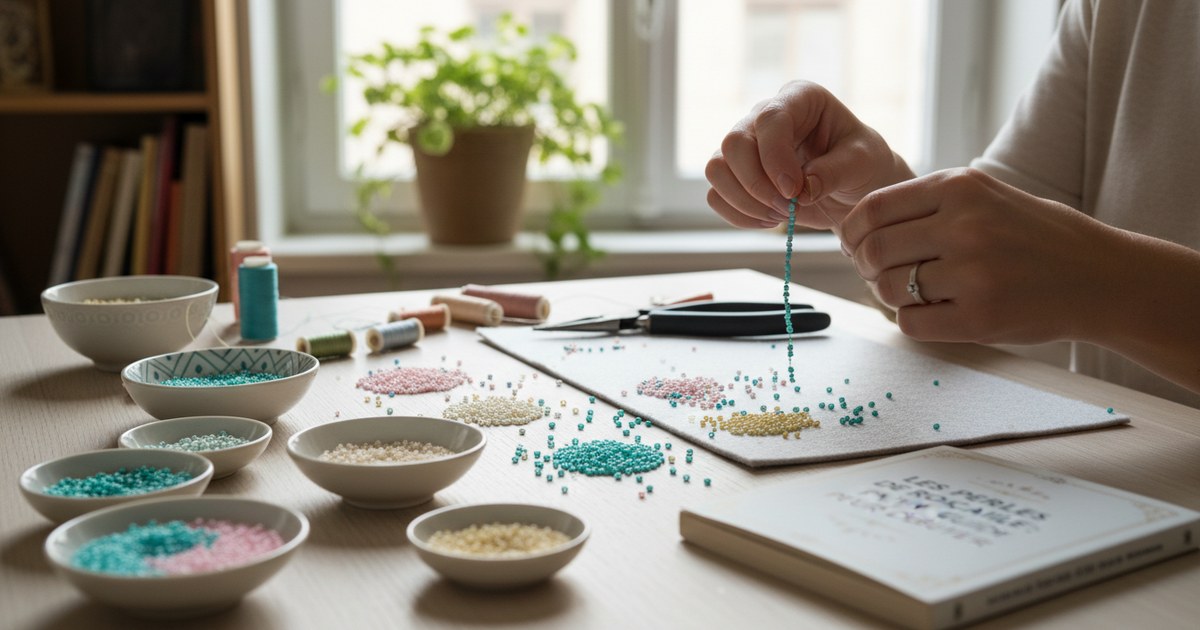
Seed beads are the tiny colored glass spheres that makers have loved for generations. They come in an endless range of colors, finishes, and sizes, and they are the essential starting material for anyone who wants to learn handmade jewelry or decorative objects.
What exactly is a seed bead?
Seed beads are small glass beads, usually round, with a diameter of about 1 to 6 millimeters. The French name rocaille is said to come from “roc,” a nod to their mineral, glossy look. Made mainly in the Czech Republic and Japan, they are known for their quality and evenness.
They are sized with an inverted numbering system: the higher the number, the smaller the bead. A size 11/0 bead (about 2 mm) is smaller than a 6/0 (about 4 mm). That scale lets makers pick the exact size a project needs.
The finishes you can choose from
Much of the appeal of seed beads is the range of finishes. Opaque beads give solid, intense color, good for bright work. Transparent beads play with the light and give a composition a lighter feel.
Pearl finishes imitate the glow of natural pearls, while metallic beads carry a silver, gold, or copper sheen. Iridescent beads shift through rainbow tones as you turn them. Matte beads have a soft, quiet surface, suited to more restrained pieces.
“Working with seed beads is like painting with little drops of light. Each piece becomes a small work of art you can wear.”
Basic techniques for a first project
Seed-bead weaving is done in several techniques, and each one opens a different kind of work. Loom weaving makes wide, even bands, good for cuff bracelets or bags. Brick stitch looks similar to loom work, but it is done by hand, with no special equipment.
Peyote, a very popular stitch, threads the beads in an offset pattern and gives a flexible, elegant surface. Right-angle weave builds geometric motifs and can be worked in three dimensions. For beginners, simple stringing is the most approachable method: necklaces or bracelets made by alternating beads, with other decorative elements if you want them.
What you need to start
You do not need to spend much to begin. A few basics are enough. Special beading needles, thin and long, pass easily through the small holes. Nylon thread or waxed cotton thread keeps a piece strong, while coated wire suits projects that need more stiffness.
A small work tray with compartments helps you sort beads by color. A pair of small pointed scissors, matching clasps, and a few jump rings complete the starter kit. Later you can add more specialized tools as you try new stitches.
Practical tips for cleaner work
- Always work on a plain, light surface, ideally a soft cloth that keeps the beads from rolling
- Store beads in labeled compartment boxes so you can find a color quickly
- Always allow about 20 percent extra thread beyond the theoretical length of the project
- Start with simple patterns before you take on a complex one
- Take regular breaks for your eyes: close work is tiring
- Do not hesitate to undo a passage that looks wrong: patience is what makes a piece look finished
Endless pieces within reach
What you can make with seed beads is genuinely open-ended. Beyond the usual jewelry — bracelets, necklaces, and earrings — you can make brooches, personalized key rings, clothing decorations, or small objects such as animals, flowers, and geometric motifs.
Some artists push beadwork as far as pictures or sculptures made entirely of seed beads. This old technique, practiced for centuries by cultures around the world, still draws and inspires new generations of makers.
Whether you want a calming hobby, a way to show your own taste, or simply the pleasure of giving someone a one-of-a-kind piece, seed beads are a generous field to work in: open to anyone, and deeply satisfying.
Leave a Reply