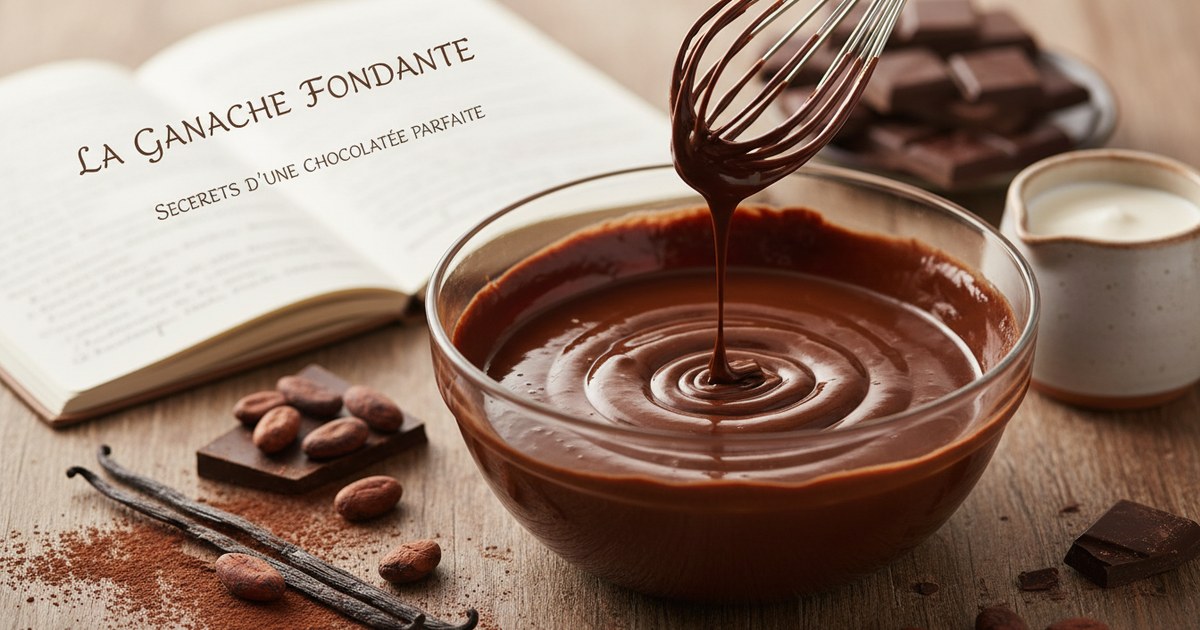
Silky ganache is one of the most emblematic preparations in French pastry. This smooth emulsion of chocolate and cream turns any cake into an irresistible dessert. Behind its apparent simplicity, though, a few technical details decide whether the ganache succeeds or fails.
What exactly is a silky ganache?
A silky ganache is a stable emulsion made when chocolate meets hot cream. Unlike a whipped ganache, or a firmer ganache used for truffles, a silky ganache stays pourable and smooth. It drapes gently over pastries and melts in the mouth, which is how it got its name.
The preparation dates back to nineteenth-century Paris kitchens. The name is said to come from a comic mishap: an apprentice accidentally poured hot cream into chocolate, and his furious master called him a “ganache” — then a word for a clumsy person. Fortunately, the mistake turned out to be delicious.
The right ratios for a perfect texture
The secret of a silky ganache is the ratio of chocolate to cream. For that characteristic pourable texture, the usual proportion is 1:1, the same weight of chocolate as of cream. For example, 200 grams of dark chocolate for 200 milliliters of whole cream.
The ratio can shift slightly with the chocolate you use. Dark chocolate, richer in cocoa, makes a firmer ganache than milk chocolate at the same proportion. For white chocolate, which is very rich in cocoa butter, the cream is often reduced a little so the ganache does not turn too thin.
“A successful silky ganache should flow slowly from the spoon in a glossy, even ribbon. That is the sign of a properly made emulsion.”
A reliable method, step by step
Start by finely chopping good-quality chocolate and placing it in a bowl. Meanwhile, heat whole cream in a saucepan until it shivers, without letting it boil. Pour the hot cream over the chocolate in three additions, pausing a few seconds between each one.
Then comes the crucial step: the emulsion. With a spatula or a flexible scraper, stir gently from the center outward in circles. Do not whisk hard, or you will beat in too much air and leave unwanted bubbles. Continue until the cream is smooth, glossy, and even.
Practical tips so the ganache never fails
- Always use whole cream with at least 30 percent fat, so the emulsion stays stable
- Choose a quality couverture chocolate with a good share of cocoa butter
- Work with completely dry tools: water is chocolate’s enemy and can make the ganache seize
- If the ganache splits, add a few spoonfuls of cold cream and stir firmly to bring the emulsion back
- Let it rest 10 to 15 minutes before you use it, so it reaches the right consistency
- Keep it in an airtight container in the refrigerator, and warm it gently over a bain-marie if you need to
Flavor variations worth trying
Once the basic method is in hand, silky ganache takes endless variations. You can flavor the cream before pouring it over the chocolate: a split vanilla bean, a cinnamon stick, orange zest, or a few ground coffee beans infused for a few minutes will add a quiet aromatic note.
If you want a stronger flavor, stir in a tablespoon of liqueur, a natural extract, or a pinch of fleur de sel after the emulsion. Each addition turns the ganache into something of its own, and it will lift entremets, eclairs, tarts, or plain biscuits.
How to use it in pastry
Silky ganache is best used warm or at room temperature. It coats cakes, fills choux, sandwiches macarons, and tops cupcakes. Poured over a well-chilled entremet, it makes a striking mirror glaze. Left at room temperature for a few hours, it thickens slightly while keeping its characteristic melt.
Mastering silky ganache opens a wide field of pastry ideas. This seemingly simple preparation only asks you to respect a few basics: good ingredients, accurate ratios, and a gentle emulsion. With a little practice, you can make ganaches worthy of a serious pastry shop.
Leave a Reply